Understanding synthetic opal.
Structure, composition, processing.
The right choice starts with the material.
 THE ART OF COLOUR
Colour through
structure.
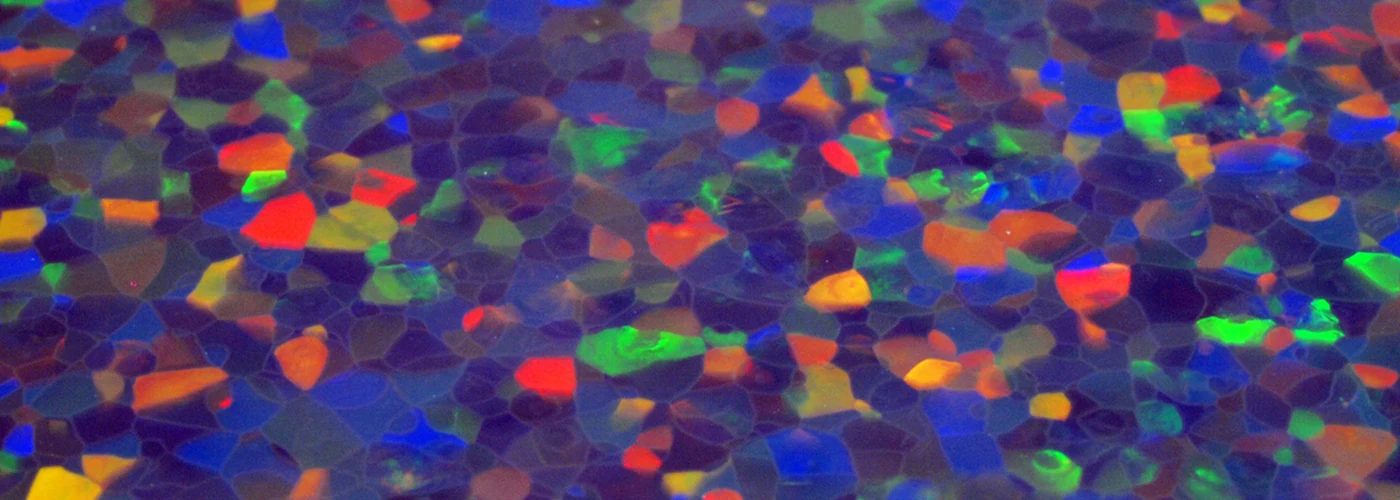
The distinctive play of colour in opal comes from the interaction of light with an ordered internal structure.
Regularly arranged silica particles influence which wavelengths of light are reflected. Colours change with the viewing angle. The size and arrangement of these structures shape the character of the material.
Lab-created opal materials can contain silica and polymers in different proportions. Names such as Aurora, hybrid and synthetic opal therefore do not automatically describe the same composition.
Similar colour.
Different structures.
| Property | Aurora Opal | Coarse crystalline hybrid opal | Polymer-impregnated opal |
|---|---|---|---|
| Pattern | Flowing swirls or flame-like patterns | Polygonal, mosaic-like | Typically columnar |
| Structure | Silica particles in a polymer matrix | Silica particles in a polymer matrix | Silica framework stabilised with polymer |
| Pattern direction | No pronounced column direction | No pronounced column direction | Directional structure |
| Our collection | Explore Aurora ↗ | Explore hybrid ↗ | For material comparison |
General material guidance. Composition, hardness and heat resistance must be confirmed for the specific material. Pencil hardness and Mohs hardness are different test methods.
From selection
to finished piece.
Jewellery & cabochons
Choose colour, pattern and material thickness to suit your design. Cutting orientation should follow the play of colour on the actual surface.
Inlays & design objects
Consider the required sheet thickness, bonding area and substrate. A material sample helps assess colour and processing behaviour in advance.
Tools, heat & chemicals
Tool choice and cooling depend on material composition. Polymer-containing opals are not suitable for encasing in hot glass. Solvents and high temperatures can damage the material; check the product-specific specification.
Finding the right
opal material.
Is Aurora opal natural opal?
No. The Aurora and hybrid opals in this collection are lab-created silica-polymer composites. Natural opal forms geologically and has a different composition. The play of colour can look similar, but origin, structure and properties must still be distinguished.
What is the difference between Aurora and hybrid opal?
Aurora opal shows finer, flowing swirls or flame-like patterns. Coarse crystalline hybrid opal shows larger, mosaic-like colour areas. Both names are used for different variants, so the specific composition and processing properties should be confirmed for the offered material.
How do I enquire about opal blocks or cutting?
Choose one or more variants from the collection and add them to your enquiry. Specify the required quantity and unit. Use the form to describe dimensions, thickness, application and cutting requirements. We confirm the offered pieces and material information in your individual quotation.
Choose opal raw materialWill each piece look exactly like the product photograph?
Product photographs show material examples. Play of colour and pattern vary within a block and between pieces. Lighting, viewing angle and screen display also affect the colours you see. For a specific design, describe the effect you need in your enquiry.
Your project begins
with a conversation.
Looking for a particular play of colour or material for your next project? Tell us about your requirements.
Enquire about your project